


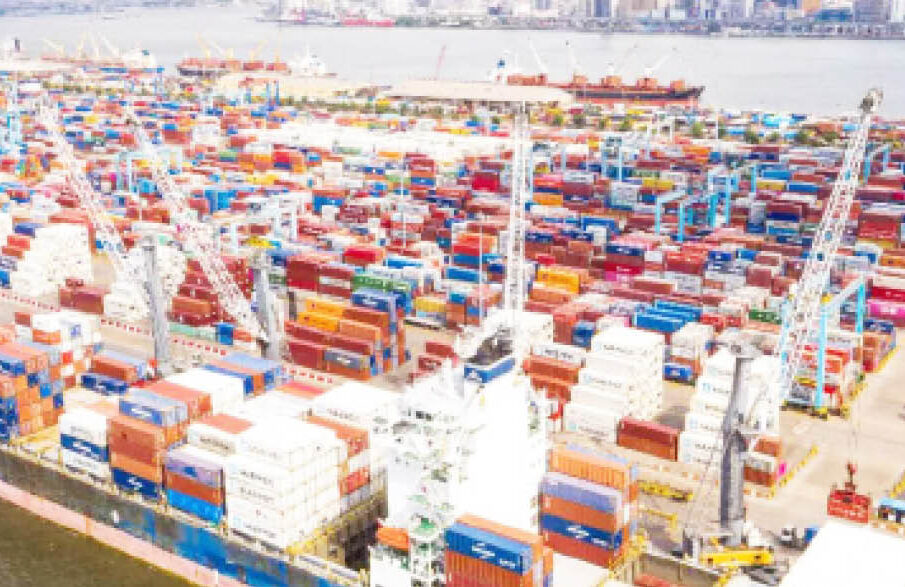
The Nigeria Customs Service has officially started collecting the 4% Free On Board (FOB) levy on imports as of Monday, August 4, 2025.
This new levy replaces the 1% Comprehensive Import Supervision Scheme (CISS) fee and is calculated based on the value of imported goods, including cost and transportation expenses up to the port of loading.
The levy which was initially introduced in February 2025, was suspended due to public outcry. However, after stakeholder consultations and a directive from the House of Representatives Committee on Customs, the levy has been re-introduced.
But surprisingly, Freight Forwarders woke up on Monday to discover that the collection of the 4% FOB had been inputted into the NCS cargo clearance system.
The discovery however elicited mixed reactions from stakeholders who felt that the seven per cent surcharge on every import ought to have been scrapped along with the 1% Comprehensive Import Supervision Scheme (CISS) fee.
The 4% levy, according to some customs licensed brokers, would increase cargo clearance costs, even though it is also intended to fund the Customs’ modernization projects and technological advancements that is expected to impact positively on clearance time for imports.
The customs licensed brokers disclosed that the average turnaround time for imports into Nigeria currently varies depending on several factors.
Dr. Eugene Nweke, founder Sea Empowerment and Research Centre (SEREC), in his analysis of the 4% FOB stated the provisions of Part V, Section 18 of the Customs Act 2023 focuses on the financing of the NCS operations.
Nweke, former National President of the Nigerian Association of Government Approved Freight Forwarders (NAGAFF), revealed that the section establishes the framework for the NCS to maintain bank accounts and receive funding from various sources, including import duties, user fees, budgetary provisions, and grants.
The 4% FOB value of imports is a significant provision, as it establishes a minimum revenue stream for the NCS. However, the provision also allows for an increase in this percentage, subject to approval by the National Assembly.
“The section also emphasizes the importance of transparency and accountability in the determination of user fees and tariff regimes. The Board is responsible for determining these fees and regimes, subject to approval by the government and the National Assembly,” he added.
Another freight Forwarder, Comrade Joy Onome Monije, stated that while she has not confirmed the new development, some of her colleagues who had told her that the 7 percent surcharge still features prominently on the customs portal as against the promise of scrapping it.
“I need to confirm before I can make a valid comment. Some said it’s been reintroduced and that the 7 percent surcharge is still in the customs portal,” she added.Another clearing agent, Subairu Abdul, confirmed the reintroduction of the 4% FOB to our correspondent.
He disclosed that a preview assessment which he made last Friday showed a duty payment of N7 million, but only to jump to N10 million as of Monday when he went to carry out proper assessment of his consignments.
“It is true. The 4% FOB has been introduced. I did a preview assessment of a consignment that I needed to clear last Friday. The assessment showed that I will pay a duty of N7 million. Surprisingly, when I went to make payment on Monday, it jumped to N10 million from the previous N7m,” he said.
The Act mandates the Nigeria Customs Service (NCS) to maintain bank accounts approved by the government, into which shall be paid: “Not less than 4% of the free-on-board (FOB) value of imports (subsection 1(a)). Revenues from assessment and collection of cost-based user fees (subsection 1(b)). Annual or supplementary budgetary provisions made by the government (subsection 1(c)).”
“Grants, aids, or donations from local or international development partners (subsection 1(d). The President may propose an increase to the 4% FOB value of imports to the National Assembly, subject to cogent and verifiable factors from the NCS.”
“Any proposal for an increase shall be determined by the Board, subject to approval by the President (subsection 3). The user fee referred to in subsection 1(b) shall be determined by the Board and approved by the government (subsection 4).”
The tariff regime for duty and excise computations shall be determined by the Board and published in the tariff handbook and website, subject to approval by the National Assembly (subsection). Notwithstanding any other law or enactment, the NCS shall be empowered to promote stability and continuity in revenue generation, trade facilitation, and economic development, subject to the provisions of this Act (subsection 6).”
SEREC’s founder, while analyzing the Act stated that: The provisions of Part V, Section 18 of the Customs Act 2023 focuses on the financing of the NCS operations.
The section establishes the framework for the NCS to maintain bank accounts and receive funding from various sources, including import duties, user fees, budgetary provisions, and grants.
The 4% FOB value of imports is a significant provision, as it establishes a minimum revenue stream for the NCS. However, the provision also allows for an increase in this percentage, subject to approval by the National Assembly.
The section also emphasizes the importance of transparency and accountability in the determination of user fees and tariff regimes. The Board is responsible for determining these fees and regimes, subject to approval by the government and the National Assembly.
The implications of these provisions are significant, as they affect the revenue generation and operations of the NCS. The 4% FOB value of imports provides a stable source of revenue for the NCS, while the provision for an increase allows for flexibility in response to changing economic conditions.
It would be recalled that manufacturers had rejected the FOB levy, saying it would have catastrophic impact on the manufacturing sector in particular, the business community and the people of Nigeria in general .”
According to MAN, what was needed at this time was the prioritization of improved trade facilitation that would mitigate the prevailing constraints militating against the optimum performance of the productive sector.
It would be recalled that the NCS had announced that it would be replacing the 1% Comprehensive Import Supervision Scheme (CISS) with the proposed 4% import levy.
The Comptroller General of Customs (CGC), Adewale Adeniyi, made this revelation at an engagement held in Lagos to sensitize stakeholders in the B’Odogwu platform.
The CGC who is also the Chairperson of the World Customs Organization (WCO) explained that, though the introduction of the 4 percent FOB had been enshrined in the constitution, the decision to reintroduce the levy was made after careful consideration and consultation with relevant stakeholders.
Adeniyi explained that the 1 percent CISS levy has been in place for several years and has been instrumental in facilitating trade and generating revenue for the government.
“Its purpose is to fund technology and modernization of Customs operations via the indigenous B’Odogwu trade platform. The transition to B’Odogwu requires significant funding,” he stated.
The CGC appealed for stakeholder’s understanding, emphasizing the need for the levy to support technological innovation in Customs operations.