


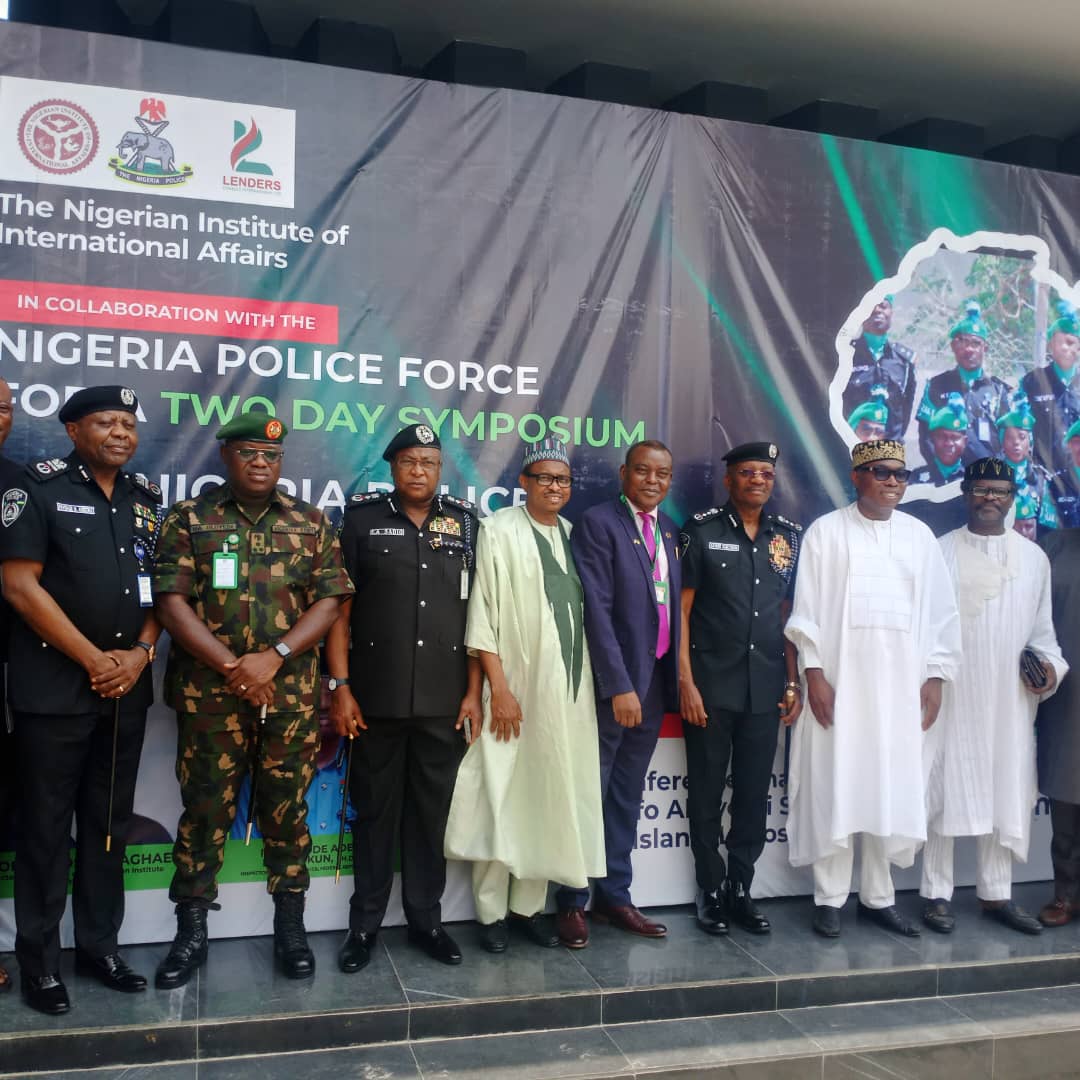
The Nigerian Institute of International Affairs (NIIA) has hosted a two-day international symposium titled “The Nigeria Police and the Peace Process in Africa”.
This is in partnership with the Nigeria Police Force (NPF), while reaffirming Nigeria’s long-standing leadership in global peacekeeping and international policing.
Director-General of NIIA, Professor Eghosa Osaghae, in his address described the Nigeria Police Force as “Africa’s showcase police force” with an extraordinary record in international peace operations spanning over six decades..
In his words, “Not many people know that in far-flung places such as East Timor, Kosovo, Haiti, Somalia, Sudan, the Czech Republic and many other global flashpoints, the Nigerian Police Force has been there, doing extraordinary things in pursuit of international peace, security and prosperity,” he said.
He noted that Nigeria’s police contributions are remembered not only in Africa but across Europe, Asia and the Caribbean, adding that Nigeria’s closest peer in peacekeeping policing globally is India.
He further explained that many Nigerian police officers who served in peace missions later rose through the ranks to become commanding officers under The United Nations (UN), African Union (AU) and ECOWAS’ frameworks, a testament to their professionalism and competence.
Osaghae posited that the Nigerian Police has played a pivotal role in global peace and security far beyond Nigeria’s borders, beginning with the United Nations peacekeeping mission in the Congo in 1960
The DG announced plans to establish, in partnership with the Nigeria Police Force, an International Centre for Peacekeeping and Policing, alongside an annual special lecture on police and peacekeeping at the Institute.
“What the NIIA does best is strengthen capacity for understanding global complexities and addressing insecurity, peace and prosperity. This partnership with a forward-looking police force will not stop here,” Osaghae said.
“To have a better police, you need a better society. The police is the mirror of our development at any point in time,” he added.
The Chairman of the occasion, Prince Dr Adewale Adebayo, who traced the historical evolution of the Nigeria Police from its establishment in Lagos in 1861 to its formal emergence as a national force on April 1, 1930 emphasized that; effective policing requires sustainable investment, capacity building and political will, while noting that no police force anywhere in the world is perfect.
He said the police has always been international in outlook, reflecting on Nigeria’s economic, political and democratic journey.
“Any commentary on a society starts with its police. The Nigerian Police Force reflects the realities of our development—its strengths and its challenges”, Adebayo explained.
“Good policing costs money. Forensics, investigations, technology, training—these are expensive. You cannot expect world-class policing without serious investment,” he further stated.
The Inspector-General of Police, IGP Olukayode Adeolu Egbetokun in his keynote address reaffirmed Nigeria’s unwavering commitment to international peacekeeping, describing it as a core expression of the country’s multilateral and global responsibilities.
According to him, “Peacekeeping is not merely the absence of armed conflict. It is the deliberate construction of conditions that allow human dignity, democratic governance, development and justice to flourish,” Egbetokun said.
He disclosed that Nigeria’s engagement in international peace operations began immediately after independence, with Nigerian police officers deployed to the UN mission in the Congo in 1960—one of Africa’s earliest police contributions to the UN peacekeeping force.
Egbetokun continued by saying that the Nigeria Police Force has maintained uninterrupted participation in peace operations under the UN, African Union and ECOWAS across Africa, Europe, Asia, the Middle East and the Caribbean since then.
In his words, “Countries where Nigerian police officers have served included: Liberia, Sierra Leone, Mali, Guinea-Bissau, DR Congo, Sudan, South Sudan, Somalia, Burundi, Angola, Namibia, Mozambique, Western Sahara, Bosnia-Herzegovina, Kosovo, Haiti, Cambodia and Afghanistan, among others”, he added.
The IGP highlighted the deployment of Nigeria’s first Formed Police Unit in 2004 as a major doctrinal shift from observer roles to robust, mandate-driven policing.
Egbetokun went further to outline the five core areas where the Nigerian Police adds value to modern peace operations. Namely:
1. Protection of civilians and community security
2. Rule of law and institutional capacity building
3. Electoral and democratic security
4. Specialised policing capabilities, including crowd control and critical infrastructure protection and lastly,
5. Leadership within global policing architecture
While acknowledging the emerging challenges associated with policing such as asymmetric threats, violent extremism, cybercrime and transnational organized crime, The Police IG explained that these challenges demand reform, innovation and stronger partnerships.
Egbetokun concluded by saying that Nigeria’s future peacekeeping role depends on aligning with The UN and AU reform agendas, strengthening specialized capabilities, modernizing institutions, enhancing language proficiency, deepening regional integration and sustaining police reform.
The symposium had diplomats, scholars, security experts, senior police officers, representatives of foreign missions and members of the media in attendance , with the mission to reinforce Nigeria’s strategic role in shaping peacekeeping and policing across Africa and beyond.