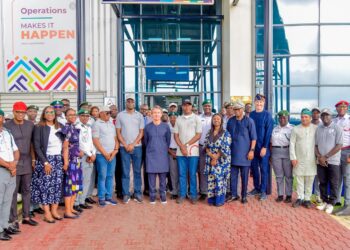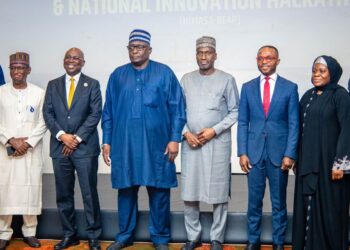




A leading financial institution in Nigeria-FirstBank has organized the 5th edition of the FirstBank Agric & Export Expo on the 16th and 17th of September, 2026, at the Convention Centre of Eko Hotel and Suites, Victoria Island-Lagos.
The 2-days event which centered on the theme “From Farm to Global Markets: Building Nigeria’s Export Value Chain”, had key industry players reiterating that traditional short-term commercial loans are inadequate for agricultural financing.
According to them, aligning credit structures with planting, harvest, and processing cycles is critical to turning farming into a globally competitive business.
Governor Babajide Sanwo-Olu of Lagos State who was ably represented at the event by the Honourable Commissioner for Agriculture and Food Systems, Ruth Olusanya, expressed the belief that the nation’s true economic strength can be unlocked, only when financial institutions are able to adapt to the unique operational realities of agribusiness.
“A good harvest without financing cannot become a good business, and a good product without access to markets cannot become a successful export.
Our financing structures must recognise the realities of agriculture, including planting and harvest cycles, rather than imposing conventional short-term financing models on long-term agricultural businesses. This is an area where institutions such as FirstBank can make a transformative difference,” The Lagos State Governor said.
Speaking further, Sanwo-Olu said: “If you produce and just export raw, you remain perpetually broke. You add value to it, you determine the global price. Cassava should not leave Nigeria only as cassava, and cocoa should not leave our shores only as raw beans”.
FirstBank Group CEO Olusegun Alebiosu noted that the 2026 expo marked a deliberate shift from dialogue to concrete execution, which focused on practical financing, market access, and business matchmaking.
The two-day hybrid event (physical and virtual via Zoom) brought together over 2,000 participants and 100 exhibitors.
Industry leaders at the event emphasized on boosting non-oil exports, improving cold-chain logistics, upgrading storage systems, and leveraging trade linkages under the African Continental Free Trade Area (AfCFTA).
The Ondo State Governor-Lucky Aiyedatiwa in his speech explained that Ondo State’s agricultural potential in cocoa, oil palm, cassava, fisheries, aquaculture, and livestock would only translate into prosperity if government and the private sector developed the full value chains around those commodities.
“Comparative advantage alone does not create prosperity. Our responsibility as government is to convert the comparative advantage into competitive advantage”, Aiyedatiwa said.
According to him, his administration is moving beyond primary production to areas such as quality inputs, aggregation, processing, storage, logistics, traceability, standards, financing, and access to domestic and international markets.
In the same vein, The Governor of Niger State Mohammed Umaru Bago reiterated the need to revitalize domestic seed-production institutions as well as deploy strategic agro-capital.
While he called for a deliberate national policy that would put priority on local food production, Bago raised the alarm that Nigeria’s continual dependence on imported food cannot sustain the country.
Some of the dignitaries at the event included: The Lagos State Governor Babajide Sanwo-Olu, Niger State Governor Mohammed Umar Bago, and representatives of the Minister of Agriculture and Food Security, Senator Abubakar Kyari and other industry leaders who reiterated the need for Nigeria to look inwards in terms of food security.