


The Correspondents’ Chapel of the Nigeria Union of Journalists (NUJ), Lagos State Council, has called for stronger collaboration between religious leaders, legal institutions, and communities to address the growing crisis of child abuse in Nigeria.
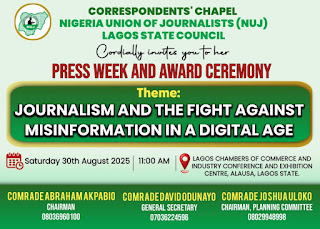
This came during the Chapel’s special symposium on child abuse, held as part of its 2025 Press Week in Lagos recently with the theme: “Breaking the Silence: Strengthening Child Protection In Nigeria “.
Delivering the keynote address on behalf of His Eminence, Primate Elijah Babatunde Ayodele, Founder of INRI Evangelical Spiritual Church, Prof. Rosemary Isibor charged churches and faith-based institutions to expand their ministry beyond prosperity preaching and engage more directly in the fight against abuse.
“The church must go under the bridges and into communities, not remain confined within its walls. Sermons should not only focus on making money, buying cars, or travelling abroad. Abuse prevention must be part of regular messages in our churches,” Prof. Rosemary said.
“We must create safe spaces for children and survivors to speak out. It is wrong to tell victims that reporting abuse will bring shame to their families. Silence only protects the abuser”, she said.
She also cautioned against harmful enemy-focused preaching while stressing that even Jesus that was killed by enemies, never preached about killing them.
Guest speaker, Barr. Osegie Queen Oniwon, Esq., a child rights lawyer, described the situation as a “legal disconnect” — noting that Nigeria might have a comprehensive child protection laws, enforcement remains the key question.
She explained that Nigeria has domesticated the UN Convention on the Rights of the Child through the Child Rights Act, with Lagos State leading efforts since 2007. Yet, children still face systemic neglect.
“Our constitution guarantees life, dignity, and freedom from discrimination, but the problem is weak enforcement agencies — the police, judiciary, and social workers,” Oniwon said.
“Children are still being held in adult prisons due to inadequate juvenile justice systems. Poverty forces many into child labour and street begging disguised as religious practice. Gender discrimination against girls and abuse in religious settings continue unchecked”, she added.
She recommended immediate strengthening of enforcement, public awareness campaigns, and expanded social safety nets. In the long term, she said, Nigeria must make education free at all levels, restore community-based child support systems, and include children in civic processes like state assemblies and children’s parliaments.
The panel discussion which was moderated by Fanayajo Ranti, examined the cultural and systemic roots of child abuse.
The Panelists included: Comrade Abraham Akpan, Prof. Rosemary Isibor, Comrade Rabiu Idris, Comrade Osiris Chinonye, Mrs Victoria Fawi, and Barr. Osegie Queen Oniwon, Esq.
They identified the most prevalent forms of abuse as physical violence, sexual exploitation (including cases involving children as young as four years old), child labour, early marriage, and neglect.
According to the panel, cultural practices, generational cycles of abuse, and gender stereotyping contribute to the problem. Religious misinterpretations and weak government policies also play a role.
”Child abuse has always existed in Nigeria, but today it is more visible because people now have phones, cameras, and social media to expose it”, a panelist said.
The discussants warned that abuse is often normalised under the guise of “discipline” or “tradition,” while victims are silenced by threats, stigma, and intimidation.
At the close of the symposium, the NUJ Correspondents’ Chapel urged stakeholders to break the culture of silence surrounding child abuse and ensure stronger protection systems for children.
The Chapel’s Chairman, Comrade Abraham Akpabio, said the event underscored the urgent need for collective action.
“We must amplify this campaign for a Nigeria where every child is safe, heard, and protected. It is our duty as journalists, leaders, and citizens to confront these realities and work together for change”, Akpabio reiterated.
The symposium formed part of The NUJ Lagos Correspondents’ Chapel’s Press Week, with participants drawn from the media, legal sector, civil society, and religious organizations.