



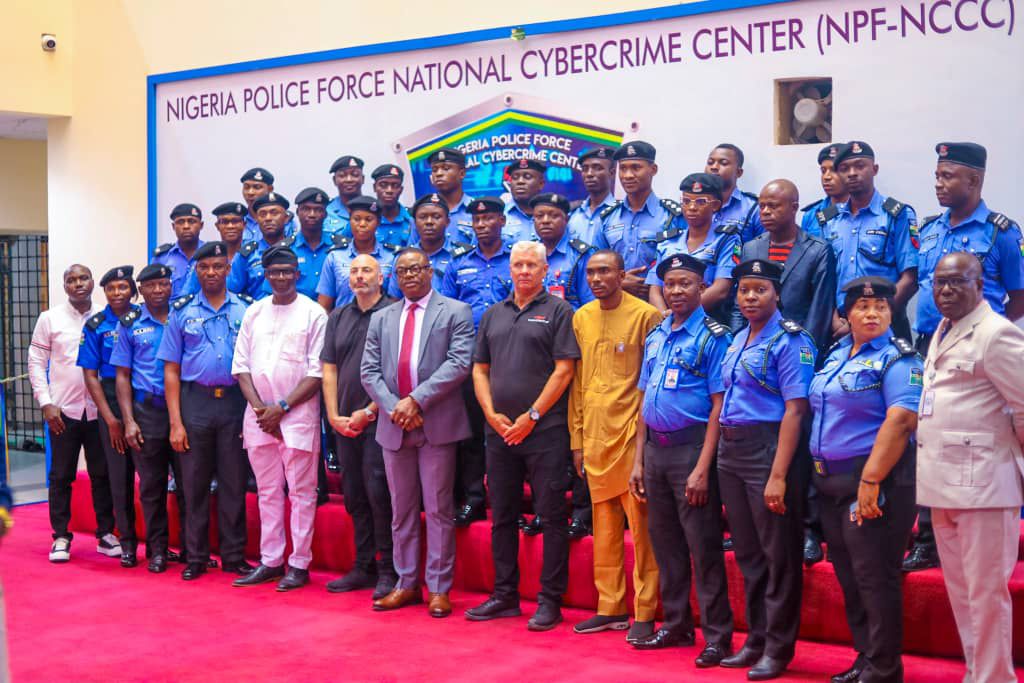
In an era where criminals no longer need to wield weapons but only keyboards and smartphones, the Nigeria Police Force has intensified its cyber warfare capacity. This time, by training 192 officers on the Athena Forensic Intelligence Solution (AFIS), one of the world’s leading tools for digital forensics and intelligence gathering.
The training, which ran between July 9 and August 15, 2025, was a collaborative effort between the Force and Radio Tactics Group Limited. Officers were drawn from across the 36 states, the Federal Capital Territory, and 10 specialized formations. For many participants, it was not just a training exercise but an eye-opener to the sophisticated methods cybercriminals now deploy.
One participant, who serves in the Lagos Command, described the experience as “a career-defining moment.” According to him, the training exposed officers to how criminals manipulate SIM cards, GPS trackers, and satellite devices to mask their activities. “We are no longer only chasing criminals on the streets. We are chasing them in cyberspace too,” he said.
The facilitators — drawn from the Force’s National Cybercrime Centre (NPF-NCCC) and Radio Tactics — took participants through practical modules including biometric capture, data extraction from grey-market phones, and how to use forensic hotlists to match intelligence records with operational data.
“This is about staying ahead of the curve,” explained a senior NPF-NCCC expert who served as a facilitator. “Cybercriminals are evolving daily. If our officers do not evolve faster, the nation will always be on the back foot.”
But the training was not just theory. Even as officers sharpened their skills in classrooms and labs, operatives of the NPF-NCCC were applying similar tools on the field. In a related breakthrough, three suspects — Gbenga Samuel, Dele Titus, and Olalekan Oke — were arrested in Abuja and Lagos for crimes spanning cyberstalking, identity theft, and online fraud.
Investigations revealed that on July 18, 2025, the suspects hacked into the WhatsApp account of an unsuspecting victim. They then threatened to leak sensitive information unless a ransom of ₦3 million was paid. What they did not know was that digital footprints, no matter how carefully concealed, leave behind trails.
A swift forensic analysis led operatives to their location, enabling coordinated arrests. Police also restored the compromised account and uncovered evidence of a wider organized cybercrime network — a discovery that is now fueling further investigations.
For Inspector-General of Police, IGP Kayode Adeolu Egbetokun, Ph.D., NPM, these developments are not coincidental but the result of a deliberate strategy to embrace digital policing. “The threats in cyberspace are dynamic and complex,” he said. “We must continually retrain our personnel and adopt modern forensic tools to secure the digital space for all Nigerians.”
Global experts argue that Nigeria’s move is timely. With Africa experiencing a surge in cybercrime — from online scams to digital impersonation — law enforcement agencies across the continent are under pressure to modernize. The AFIS training places Nigeria among countries actively preparing their police forces for 21st-century threats.
Security analysts have described the dual development of training and arrests as a “two-pronged victory” — one that builds long-term resilience while delivering short-term operational results. “What Nigerians want to see is not just training, but real arrests,” said one analyst. “This initiative proves both can happen side by side.”
For the newly trained officers, the responsibility is clear. As one female officer from the North-East put it, “We now hold the tools to fight invisible enemies. It is our duty to ensure Nigerians can browse, chat, and transact online without fear.”
As cybercriminals continue to devise new tactics, the Nigeria Police Force has sent a strong message: in today’s digital age, technology is no longer the exclusive weapon of criminals. The guardians of the law are now equally armed — and better prepared than ever.